

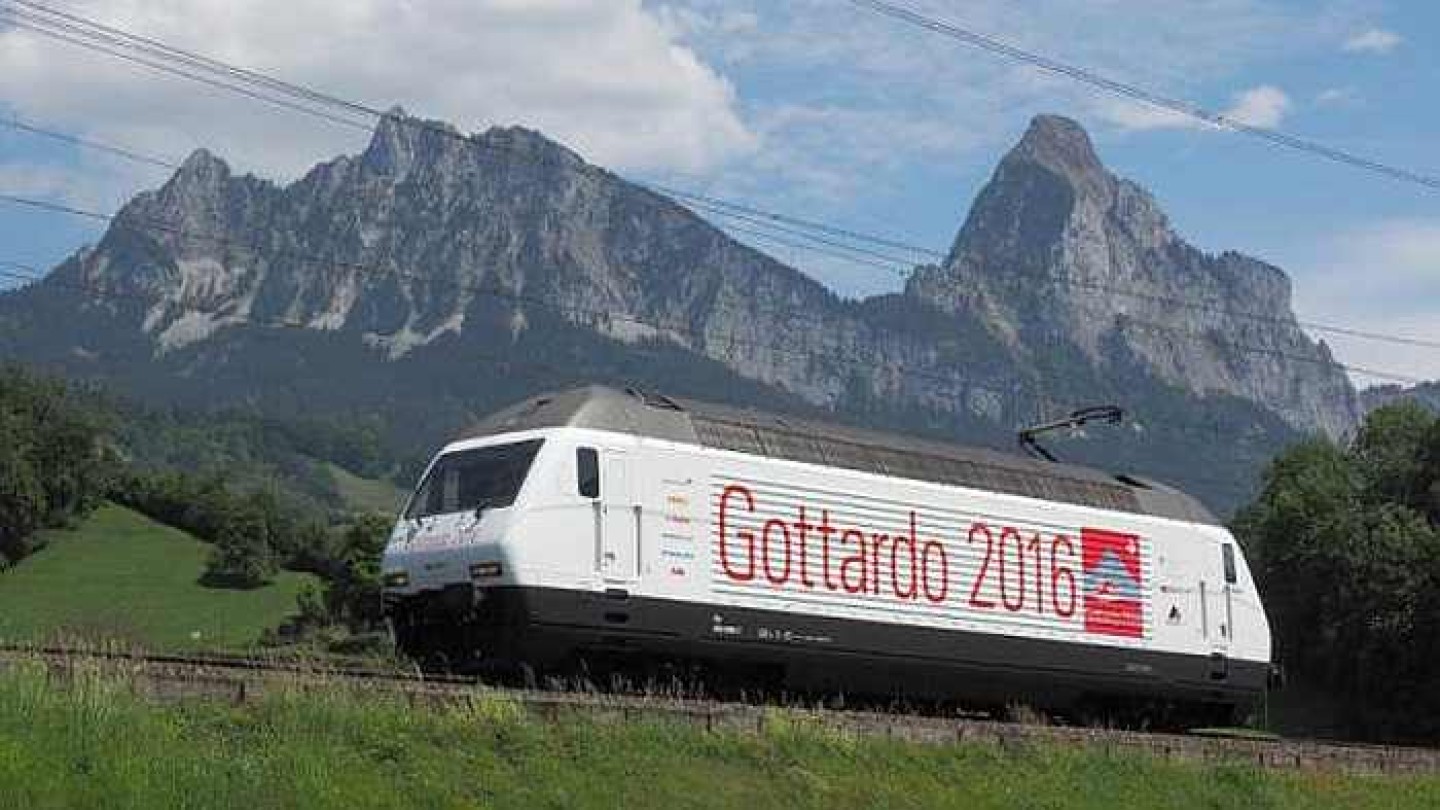
1 June 2016 – Italy is upgrading its rail network in order to shift part of freight traffic from road to rail, with the key goal of reaching at least 30% of freight rail capacity by 2020. We are currently working on the four TEN-T Corridors which cross Italy, from passes to the Southern sea-ports in line with the Reform on ports and logistics -National Strategic Plan for Ports and Logistics – promoted by the Minister of Infrastructures and Transport Graziano Delrio.
Italy is separated by the rest of Europe by the highest mountain range of the European continent and is facing a real challenge with the support of the EU Commission - a challenge which involves four different countries - for the implementation of the rail tunnels and rail connections of this area.
GOTTHARD BASE TUNNEL
Benefits of Gotthard base tunnel for Italy
The Gotthard base tunnel is the most important project of the Rhine-Alpine Core Network Corridor, connecting the North Sea Port of Rotterdam to the Mediterranean basin in Genoa, crossing a strong economic area whose gross domestic product (GDP) accounts for 16% of EU GDP.
As for Italy, the Gotthard base tunnel will make Italian sea ports, located in its southern part - Genoa and Vado Ligure - act as connecting points between the North Mediterranean area and the economy of the New World whose transport network passes through the Mediterranean Sea. Through the Rotterdam-Genoa route, the connections between these markets and those of Northern and Central Europe will be facilitated.
On June 1st , at Genoa Prà Port the first 5 cranes by the Psa Singapore were inaugurated, enabling the loading/unloading operations of container vessels of up to 22.000 TEUs of capacity for a total number of container movements of about 2 million per year, aiming at creating port infrastructures closely linked to railway system.
The new rapid and efficient railway connection will enable trains to cross the Alps with the least gradients and broad-curves.
Rail travel times between Switzerland and Italy will be significantly reduced from 11 December 2016, date of operation, providing more routes and services in order to reach three hours of journey to get from Milan to Zurich with the completion of Ceneri Base Tunnel in 2020.
Italy has a priority interest in railway infrastructure development included in Rhine-Alpine Corridor as well as European Corridors in general, for their strategic contribution to competitiveness, economic growth and job creation. Good from Netherlands, Belgium and Germany will be transported southward along the Rhine-Alpine Corridor and also cargo from Italy going to the North of the Alps, bringing benefits to Italian economy, will be operational. In 2015, the imports from Switzerland, Germany, Netherlands and Belgium amounted in total to 26% per year, and export activities amounted in total to 22,7% per year; these are the highest percentages.
Translation of the above figure: Development of new potential with the Genoa-Rotterdam Corridor implementation from 2017.
Italian contribution to Gotthard base tunnel implementation. What are we doing?
On the Italian side of the Gotthard Base Tunnel, infrastructural and technological upgrading works are currently being carried out by RFI Company (Italian Railway Network of Ferrovie dello Stato Group), on the rail lines of the TEN-T European Core Network Rhine-Alpine Corridor included in Alptransit construction project, which will enable to enjoy the benefits deriving from the projects already implemented. The completion of the works are scheduled by 2020, to be carried out in cooperation with Switzerland. In 2020, when all the infrastructure works of both Italian and Swiss sides will be completed, a traffic capacity of 390 trains per day will be provided, compared with 290 trains per day actually provided , of which 170 trains along the Chiasso Pass, 90 trains along Luino Pass and 130 trains along Domodossola pass. There are actually 16 construction sites managed by the RFI Company (Ferrovie dello Stato Group) and the current available resources for railway lines implementation amount to EUR 3,3 billion.
Works of Italian side included in the Rhine-Alpine Corridor and which are foreseen in the Memorandum of Understanding (MOU) signed between Italy and Switzerland in 2012.
Works are being carried out in line with the above agreements and with a view to the full entry into operation of the railway system by 2020.
Arcistate - Stabio
As for Arcistate-Stabio railway project, the 60% of the project has been implemented. The works (civil works, full fitting out of the electrical line, electric traction) will be completed in late spring 2017; the entry into operation is scheduled by December 2017.
Luino rail Pass
The single track route Novara/Gallarate-Luino rail line. Works on the upgrading of the existing tracks are currently underway as well as works on technological improvement providing new computerized system for implementing rail traffic control and management system. Modernization of the system for the safety distancing of trains. Infrastructure works were put into operation in 2015. The Laveno-Mombello rail project will be put into operation in 2016. The works on the modifications of the gauge of the tunnel line section will be started in order to enable the rolling highway service: in some rail stations upgrading works will be carried out. The rail line is interested with a combined freight and passenger traffic and will remain unchanged with a regional passenger transport capacity of 30 trains per day and freight transport capacity of 40 trains per day.
Chiasso rail Pass
Milan-Como-Chiasso railway line: works on technological development of the traditional railway line are currently underway. The works on freight traffic will be completed by 2018. Technological development will be completed by 2019.
Genoa-Milan High-Speed/High-Capacity Railway Line (also known as Terzo Valico dei Giovi)
Italy has been planning for long time the strategic railway infrastructure “Terzo Valico” which will cross Ligurian Apennines and along with Swiss railway system will complete the connection between the hub of Genoa / Ligurian Ports with the Northern Range ports of Rotterdam, Amsterdam, Antwerp and Zeebrugge.
The port of Genoa, with its several railway lines is connected to Piedmont and Lombardy Regions, highly industrialized areas. The “Terzo Valico” project will therefore be the natural completion of Ceneri-Gotthard tunnel project. An important impetus has been given to the works which have registered an implementation of 80% for the first construction lot and of 35% in total for the first three lots which have already been funded. The current available resources amount to EUR 3,5 billion, if we include the fourth lot with an estimated value of EUR 1,6 billion still to be submitted to CIPE.
OTHER CORRIDORS AND PASSES
Works in progress in Italy on other European passes and Corridors.
Scandinavian-Mediterranean Core Network Corridor: Brenner Base Tunnel
The works are focusing on the new Brenner Base Tunnel. The implementation works on Italian and Austrian sides, as well as on the common sections of the Corridor, are currently underway. From the opening of this tunnel, scheduled by 2025, Italy is expected to increase its traffic capacity of 400 trains, (currently 290 trains a day), along with improving the rail traffic performance, a more efficient management of cross-border traffic and, in general, the reduction in journey times for travelling from Fortezza to Innsbruck.
The current resources for the implementation of Brenner Base Tunnel amount to EUR 3 billion compared with the estimated cost of EUR 4,4 billion.
The current resources for Corridor’s railway lines, amount to EUR 8,846 billion. The investments also concern other projects along Italy and in the South of Italy too, such as Naples-Bari high-speed/high-capacity rail line (high-speed system is only foreseen for freight transport) for which two construction lots have been authorized in the last days for a total investment amount of EUR 1,4 billion.
Baltic-Adriatic and Mediterranean Core Network Corridors: Tarvisio rail pass
Tarvisio rail pass is actually operating. Works for infrastructural and technological upgrading are currently underway as regards Tarvisio-Udine-Cervignano and Venice-Trieste railway sections. The first project on Tarvisio-Udine rail line is being completed. Construction works in the South part of Udine will be started very soon as well as the first project stage for accelerating Venice-Trieste railway line, on the common border section between the two Corridors. Every day, from Trieste sea-port are leaving 5,600 freight trains. Resources actually available to be allocated amount to approximately EUR 225 million. The completion of the project is scheduled by 2020.
Mediterranean Core Network Corridor: high-speed/high-capacity Turin-Lyon rail line
The infrastructure projects concern the implementation of the whole rail line crossing the North side of Italy including the new high-speed/high-capacity Turin-Lyon rail line, Milan-Verona and Verona-Padua rail sections, the speeding-up of Venice-Trieste railway line as well as the new Trieste-Divaca railway line.
Italy is expecting a significant improvement in rail performances while crossing the Alpine Area by the completion of the new Turin-Lyon high-speed railway line, as well as cost reduction reasonably estimated at 40% of the total value. Works are currently underway. From July 2016 at Saint Martin de la Porte, the excavation of the geognostic gallery will be started in the axis of the Base Tunnel. The Agreement between France and Italy on the cost of the works has recently been signed in Venice.
DELRIO
Speech of the Minister of Infrastructure and Transport Graziano Delrio
“For the Government headed by Prime Minister Renzi, the development of freight rail transport compared to road transport, is a core target to be achieved, which will mean more sustainability and efficiency. We are investing a lot in Italian rail network an in the development of the connections to the four European Corridors because Italy can be the Southern Port of Europe in the Mediterranean Sea, due to its geographical position. We want to double by 2021 the 2015 values of the goods transported by rail in Italy, as well as promoting the development of sea port system. Our country needs to put in to place “iron” and “water” options.
The new Gotthard Base Tunnel is the key project of Rhine-Alpine TEN-T Core network Corridor, running from Rotterdam to Genoa, which means shorter journey times, better quality standards, more safety and higher number of trains. We are working hard to improve rail connections with a view to the opening of the Ceneri base Tunnel scheduled by 2020; Italy is very much in line with all these important infrastructure projects".